Water supplies across the Tasman District from Murchison to Collingwood are regularly tested. None of our water supplies have fluoride added.
For results of groundwater quality related to State of the Environment (SOE) Monitoring, head to the Groundwater Water Quality Data page.
Some testing undertaken as part of SOE monitoring has drinking water quality relevance, but SOE samples are not a comprehensive testing suite for drinking water.
If you would like assistance or further information about water supply quality, please contact us.
Read the information guide (pdf 1.9 MB) for those who get their water from a private bore or well.
In addition to regular testing for public health, people interested in home brewing will find water quality information useful. In addition, Some newer dishwashers also require 'hardness' information.
Note that if you need ‘hardness’ in mmol/l, rather than mg/l as CaCO3 (as reported here, simply divide the reading by 100 to get an approximate answer. (e.g. Richmond 135mg/l becomes 1.35mmol/l).
There’s a simple way to know if you’re on bore water or not.
If you receive a water bill, you are on a council water supply, but if you don’t, then you’re either on a bore or rainwater tank supply – although some Motueka properties on bores do pay a firefighting levy.
We want to remind residents taking water from their own private bores to ensure that the water consumed by their household is safe.
Residents abstracting water from shallow aquifers which are vulnerable to contamination have a responsibility to have adequate water quality treatment systems in place to ensure their water is safe from potential sources of contamination.
It is also important for landowners to know activities on their properties can have an impact on the water quality in the underground aquifer where the water comes from.
If you have a bore on your property, please ensure contaminated water cannot get back down into the bore either through flooding or backflow.
Contamination can include stagnant water near the well, localised seepage into the well, animal faecal contamination, septic tank seepage, and runoff/seepage following rainfall.
Even if the water from your bore looks clean and smells fine, contamination cannot normally be noticed just by looking at or smelling it.
That’s why it’s important to have a water quality treatment system in place which will ensure the water is safe to drink.
There are a number of treatment options available, ranging from boiling through to filtering, chemical or UV treatments.
If you’re on a private water supply and you have concerns about your drinking water safety, we recommend you:
If you need advice about water quality from private water supplies, please do not hesitate to contact us and ask to speak to an environmental health officer.
If you have a private bore, anywhere in the District, it is recommended that you boil your water following flooding.
Shallow bores in any location can be contaminated from surface water, but especially when there has been heavy rain and groundwater levels rise to be much closer to the surface than normal.
This is always recommended following a flood event but exactly how long for will vary depending on the event. We would refer you to the Health NZ guidance.
The Water Services Authority - Taumata Arowai - has valuable advice about drinking water safety.
If you want to test your water for bacterial contamination, it can be tested for e.coli as an indicator of contamination. A laboratory can do the test.
Cawthron Laboratories - 98 Halifax Street East, Nelson 7010. Phone 03 548 2319
Hills Laboratory - Phone 0508 44 555 22 or +64 7 858 2000
Chlorinating water ensures it always remains safe to drink.
Chlorine provides excellent protection against the risks of bacteria and from some viruses. We have prepared background material for people who have concerns about chlorination.
Tasman District Council does not add fluoride to any of the water supplies it owns and operates. Fluoride does occur naturally at low levels, however.
Any decision to require fluoride to be added to any water supply is made by the Director General of Health, not Council. We have not, at this time, been directed to do so, nor are any of our supplies on the list of those being actively considered.
This link to the Ministry of Health provides relevant information on this topic.
The National Drinking Water Standards require regular testing to be done at all of the plants and in the zones on a set schedule.
The testing we do varies depending on the plant, but generally involves taking a sample to be tested in the lab for E.coli and other on-site tests such as chlorine level. Zone samples might be taken at reservoirs or at the farthest reach of that system.
The main lab testing is for E.coli, but we also test for lead and nitrate. On site we also regularly test for pH, chlorine and turbidity (cloudiness of the water).
We can also monitor the performance of every treatment plant online through our telemetry system. Should anything go wrong, an alarm will be generated in the system and this will be texted to the on call person to let them know straight away.
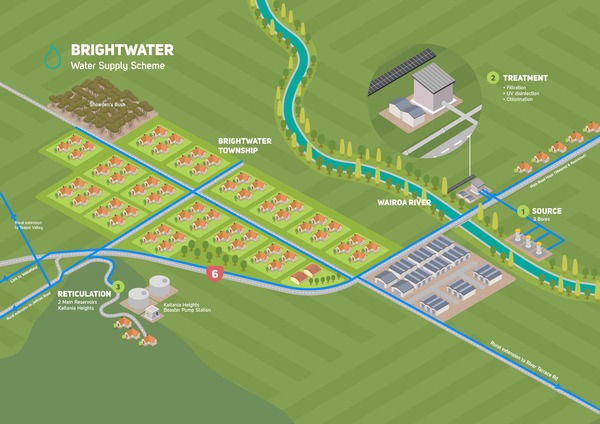
Brightwater Water Supply covers the urban Brightwater area, and extends along Main Road Hope to the southern side of Bateup Road in Richmond.
Water is taken from three bores close to the Wairoa River in Brightwater. The water is chlorinated for disinfection purposes.
| Parameter | Concentration | Units |
|---|---|---|
|
pH |
Approx 7 |
|
|
Turbidity (cloudiness) |
<0.2 |
NTU |
|
Hardness (total) |
50 |
mg/l as CaCO3 |
|
Calcium |
10 |
mg/l |
|
Magnesium |
6.1 |
mg/l |
|
Manganese |
<0.0005 |
mg/l |
|
Nitrate |
0.3-0.5 |
mg/l as Nitrate-Nitrogen |
|
Lead |
<0.001 |
mg/l |
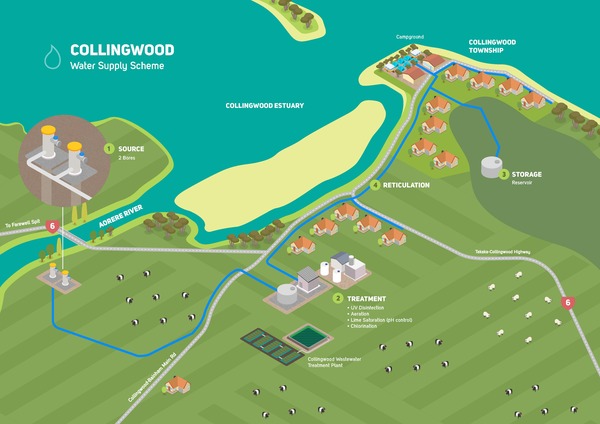
Collingwood Water Supply takes water from a bore near the Aorere River. The water is aerated and passes through a lime filter for pH control. The water is chlorinated for disinfection purposes. The scheme is fully metered except for one connection
| Parameter | Concentration | Units |
|---|---|---|
|
pH |
6.5 |
|
|
Turbidity (cloudiness) |
<0.2 |
NTU |
|
Hardness (total) |
25-30 |
mg/l as CaCO3 |
|
Calcium |
9 |
mg/l |
|
Magnesium |
1.4 |
mg/l |
|
Manganese |
0.005 |
mg/l |
|
Nitrate |
0.25 |
mg/l as Nitrate-Nitrogen |
|
Chloride |
8.5 |
mg/l |
Dovedale water supply is under a Permanent Boil Water Notice.
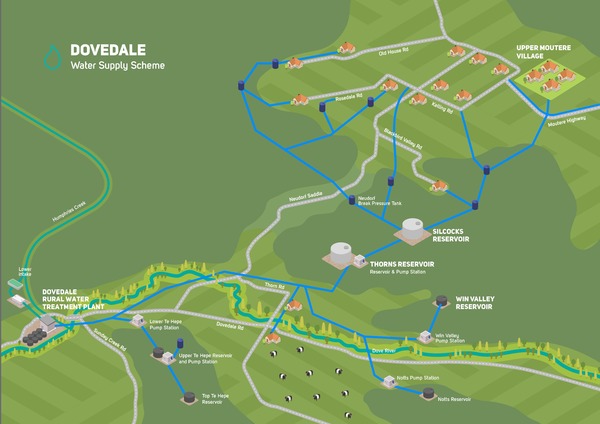
The Dovedale water supply is a rural network supply that provides drinking water for households as well as water for stock and irrigation across the Dovedale area, Upper Moutere, and Rosedale Road.
The network is large, rural, steep hilly and rugged terrain over an area of approximately 12,000 hectares and with approximately 145km of pipe reticulation. The area is dependent on pumping so there are multiple pump stations and water storage tanks, including break‑pressure tanks.
The water is supplied into property owners’ storage tanks as a constant trickle flow through a restrictor valve sized for the required number of water units. Customers are required to have three days on-site storage under the Councils bylaw and recommended to have seven days of storage to provide for water in case of pipe bursts, etc.
Water is sourced from a weir in Humphries Creek, a tributary of the Dove River.
The Dovedale Water Treatment Plant processes include –
Water is chlorinated to protect against bacteria (such as E. coli) and this also provides some ongoing protection throughout the distribution network in case any contamination occurs after treatment.
The plant operates continuously to maintain network pressure, ensure a reliable supply to properties and minimise wear and tear on essential equipment such as pumps. However, the water supply—or parts of the network – is susceptible to temporary shutdowns, most commonly due to pipe bursts.
A permanent boil water notice is in place because there is no protozoa (including Giardia and Cryptosporidium) treatment in place and the quality of the source water varies significantly, making it difficult to consistently treat using chlorine alone.
The water source is vulnerable to weather conditions within the catchment’s steep terrain. During heavy rainfall, turbidity (cloudiness) and sediment levels increase in the water entering the treatment plant. While larger particles are removed in the sediment tank, finer sediment can pass through the treatment process and into the distribution network.
This fine sediment can cause operational issues, including pump wear, pipe blockages, and sediment settling in storage tanks. High turbidity water can also shield microorganisms from disinfection and significantly increase chlorine demand, making it harder to effectively treat the water and can lead to the creation of disinfection by-products.
Prolonged dry weather spells can reduce creek flows and at times, the Council may ask the community to conserve water.
Water is tested for bacteria and different chemicals in the raw water entering the treatment plant, in the treated water leaving the plant and set locations in the distribution network.
The table shows the standard, median or range of values for some source water parameters, in comparison to the maximum acceptable values set in the Drinking Water Standards for New Zealand (DWSNZ MAV) and aesthetic values.
Samples are taken at the treatment plant before treatment, so the results reflect water from the stream source and the raw water pipeline to the plant.
|
Parameter |
Value |
DWSNZ MAV |
Aesthetic Value |
Units |
|
pH |
7.23 |
|
7 - 8.5 |
pH |
|
Turbidity |
1.62 – 98.7 (range) 4.1 (Median) |
|
≤ 5 (appearance) |
ntu |
|
Iron |
0.151 – 3.6 |
|
≤ 0.3(staining) |
mg/L |
|
Manganese |
0.0077 - 0.149 |
0.4 |
≤ 0.04(staining) ≤ 0.10 (taste) |
mg/L |
|
Nitrate |
0.096-0.83 |
11.3 |
|
mg/L as NO3-N
|
|
Arsenic |
< 0.0011 |
0.01 |
|
mg/L |
Water quality is checked for various parameters at set locations across the network. The table shows the standard, median or range of values for some source water parameters, in comparison to the maximum acceptable values set in the Drinking Water Standards (DWSNZ MAV) and aesthetic values.
Water samples are taken from sites close to the main pipeline, meaning the water quality at your tap may be different because of storage tanks and home pipes and fittings.
|
Parameter |
Value |
DWSNZ MAV |
Aesthetic Value |
Units |
|
|
Bacteria (E. coli) |
<1 |
< 1 |
|
MPN/100ml |
|
|
Bacteria (Total coliforms) |
<1 - >201 |
|
|
MPN/100ml |
|
|
Chlorine (FAC) |
0 - 3 (range) 0.8 (median) |
5 |
0.3 – 1.0 (taste/odour) |
mg/L |
|
|
Antimony |
< 0.00021 |
0.02 |
|
mg/L |
|
|
Cadmium |
< 0.000053 |
0.004 |
|
mg/L |
|
|
Chromium |
< 0.00053 |
0.05 |
|
mg/L |
|
|
Copper |
0.0034 - 0.0059 |
|
≤1 (staining) |
mg/L |
|
|
Lead |
< 0.00011- 0.00065 |
0.01 |
|
mg/L |
|
|
Mercury |
< 0.00008 - < 0.00011 |
0.007 |
|
mg/L |
|
|
Nickel |
< 0.00053 |
0.08 |
|
mg/L |
|
Laboratory testing of the treated water in the network shows that one disinfection by-product (DBP) – Dichloroacetic acid – continues to be elevated on occasions to just above the Maximum Acceptable Value (MAV) specified in the Drinking Water Standards for New Zealand.
When source waters like Dovedale’s have higher levels of turbidity (due to the presence of organic matter), DBP’s may be produced because of the interaction between the chlorine, which is the disinfectant, and the organic matter. The World Health Organisation is clear that controlling disinfection by‑products is important, but not at the expense of disinfection. Council needs to continue using chlorine to reduce the very real risk of illness‑causing bacteria in this water.
Further information on DBP’s and other chlorine-related issues can be found on the Water Services Authority – Taumata Arowai, website - Chlorine | Taumata Arowai.
Because of the water quality and quantity issues described above, Council is investigating a different and higher quality source water for Dovedale. We continue to conduct source yield and water quality investigations on test bores and depending on the outcome, we plan to implement a new source and upgraded treatment within approximately three years (2029).
There is now a permanent boil water notice in place on this supply. Read more here.
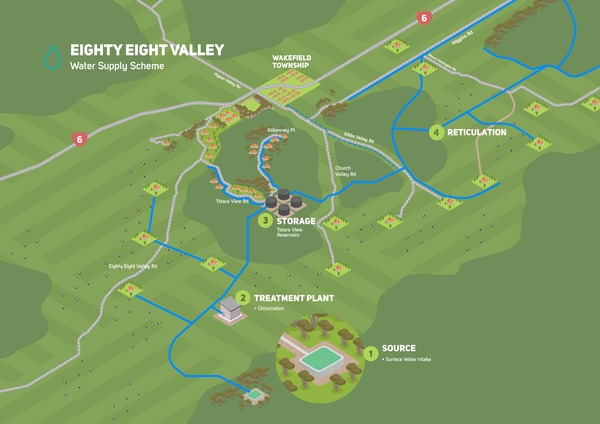
Eighty-Eight Valley Rural Water supply takes water from a creek close to the southern end of Eighty-Eight Valley Road.
Water is supplied to the rural 88 Valley Road area and as far north as Mount Heslington Road.
The water has coarse filtration and then is chlorinated.
Water is supplied entirely by restricted connections to private water tanks. No new units are being sold on this water supply.
| Parameter | Concentration | Units |
|---|---|---|
|
pH |
6.7 |
|
|
Turbidity (cloudiness) |
Generally <1 |
NTU |
|
Hardness (total) |
46 |
mg/l as CaCO3 |
|
Calcium |
12.5 |
mg/l |
|
Magnesium |
3.5 |
mg/l |
|
Manganese |
<0.0005 |
mg/l |
|
Nitrate |
0.03 |
mg/l as Nitrate-Nitrogen |
|
Nitrite |
<0.002 |
mg/l as Nitrite-Nitrogen |
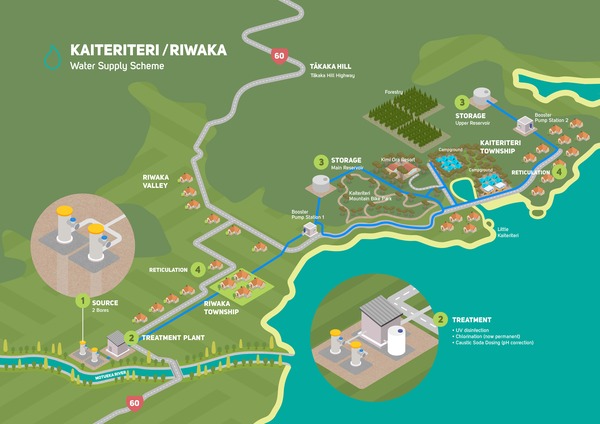 Diagram of the Kaiteriteri water supply
Kaiteriteri water supply takes water from a deep bore in Riwaka.
Water is supplied to Main Road Riwaka, most of Riwaka-Kaiteriteri Road and as far north as Kaiteriteri-Sandy Bay Road.
Permanent chlorination was introduced in May 2021. All connections are metered.
| Parameter | Concentration | Units |
|---|---|---|
|
pH |
6.2 |
|
|
Turbidity (cloudiness) |
<0.2 |
NTU |
|
Hardness (total) |
59 |
mg/l as CaCO3 |
|
Calcium |
14 |
mg/l |
|
Magnesium |
5.8 |
mg/l |
|
Manganese |
<0.00053 |
mg/l |
|
Iron |
<0.02 |
mg/l |
|
Chloride |
5.3 |
mg/l |
|
Nitrate |
2-3 |
mg/l as Nitrate-Nitrogen |
|
LSI |
-2.5 |
|
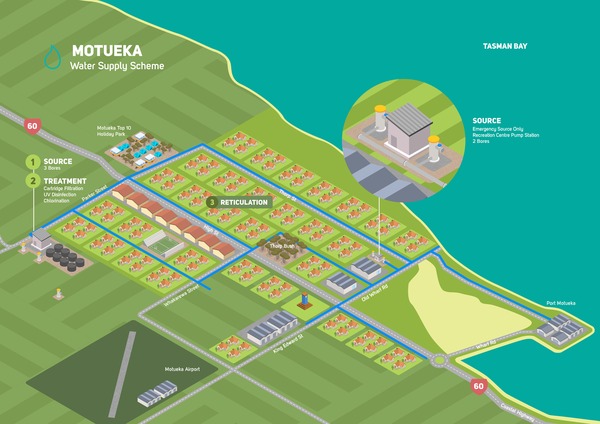
Diagram of the Motueka water supply
Motueka water supply covers only a third of the town, with many properties having their own private bore water supply (sometimes as well as a council supply connection).
The Council supply takes its water from deep groundwater bores. Permanent chlorination of the supply was agreed by Council in May 2021 and will be introduced in due course.
| Parameter | Concentration | Units |
|---|---|---|
|
pH |
6-6.2 |
|
|
Turbidity (cloudiness) |
<0.2 |
NTU |
|
Hardness (total) |
80 |
mg/l as CaCO3 |
|
Total Calcium |
22 |
mg/l |
|
Chloride |
6.5 |
mg/l |
|
Magnesium |
6.4 |
mg/l |
|
Sulphate |
10.6 |
mg/l |
|
Manganese |
0.00129 |
mg/l |
|
Total iron |
>0.02 |
mg/l |
|
Nitrate |
1.5-2 |
mg/l as Nitrate-Nitrogen |
|
LSI |
-1.1 |
|
|
Reactive silica |
14.2 |
mg/l as SiO2 |
|
Total alkalinity |
68 |
mg/l as CaCO3 |
|
Lead |
<0.001 |
mg/l |
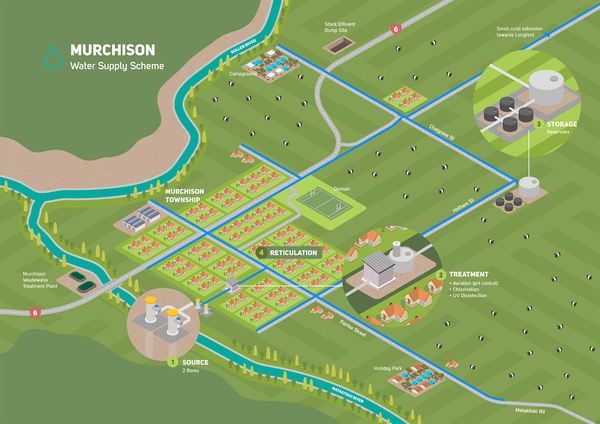
Diagram of the Murchison water supply
Murchison water supply takes it water from two bores close to the Matakitaki River.
The water is aerated for pH control and then chlorinated and UV treated for disinfection purposes.
The scheme is almost fully metered.
| Parameter | Concentration | Units |
|---|---|---|
|
pH |
6.7 |
|
|
Turbidity (cloudiness) |
<0.1 |
NTU |
|
Hardness (total) |
51 |
mg/l as CaCO3 |
|
Dissolved Calcium |
15 |
mg/l |
|
Magnesium |
3.3 |
mg/l |
|
Total alkalinity |
39 |
mg/l as CaCO3 |
|
Manganese |
0.002 |
mg/l |
|
Nitrate |
4.3 |
mg/l as Nitrate-Nitrogen |
|
LSI |
-1.2 |
|
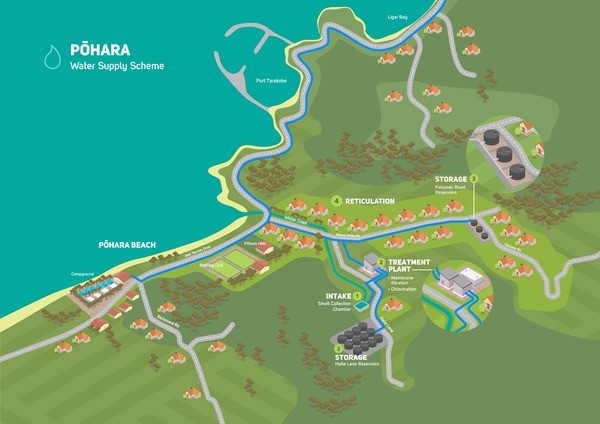
Diagram of the Pōhara water supply
The Pōhara water supply takes water from a creek in Pōhara Valley. The water is filtered and chlorinated. Only the Pōhara Valley area is supplied, with an extension to the Pōhara Camp.
| Parameter | Concentration | Units |
|---|---|---|
|
pH |
6.5 |
|
|
Turbidity (cloudiness) |
2-3 |
NTU |
|
Hardness (total) |
26 |
mg/l as CaCO3 |
|
Calcium |
6.4 |
mg/l |
|
Magnesium |
2.4 |
mg/l |
|
Manganese |
0.014 |
mg/l |
|
Nitrate |
1 |
mg/l as Nitrate-Nitrogen |
|
Nitrite |
<0.002 |
mg/l as Nitrite-Nitrogen |
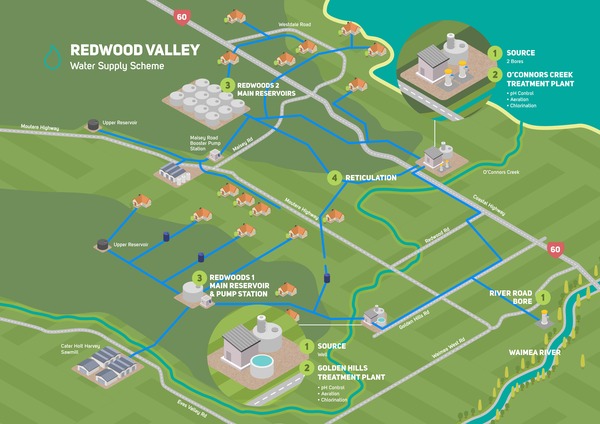
Diagram of the Redwood Valley rural water supply
There is a permanent boil water notice in place on this supply. Read more here.
Redwood Valley Rural Water Supply takes water from three shallow bores in the Redwood Valley/ Waimea plains area.
The water is aerated for pH control and then chlorinated for disinfection purposes.
There are currently no new units being sold on this supply.
| Parameter | Concentration | Units |
|---|---|---|
|
pH |
6.2 |
|
|
Turbidity (cloudiness) |
<1 |
NTU |
|
Hardness (total) |
56 |
mg/l as CaCO3 |
|
Calcium |
7.8 |
mg/l |
|
Magnesium |
8.8 |
mg/l |
|
Manganese* |
0.003 to 0.56 |
mg/l |
|
Aluminium |
0.010 |
mg/l |
|
Alkalinity |
46 |
mg/l as CaCO3 |
|
Copper |
0.001 |
mg/l |
|
Chloride |
15 |
mg/l |
|
Iron * |
<0.002 to 0.9 |
mg/l |
|
Lead |
<0.003 |
mg/l |
|
Sodium |
13 |
mg/l |
|
Sulphate |
14 |
mg/l |
|
Nitrate |
0.7 |
mg/l as Nitrate-Nitrogen |
(*treated water and raw water respectively)
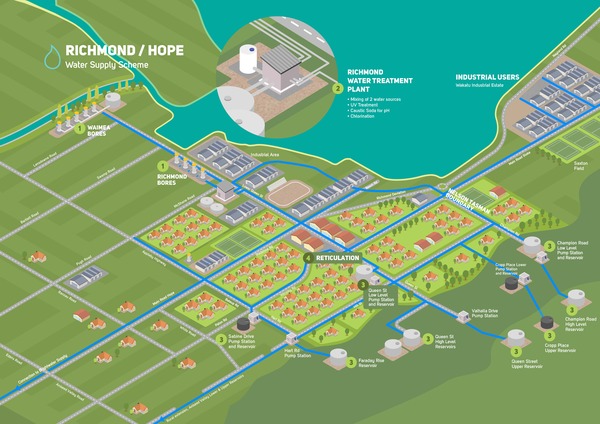
Diagram of the Richmond water supply
Richmond water supply covers properties from Wakatu Industrial Estate in the north to Haycock Road rural extension in the south. It includes the Richmond and Waimea Industrial zones.
The ‘Richmond zone’ covers the urban area as far as Templemore Drive and Arbor Lea Ave. The supply extends south to Bateup Road, and includes a rural extension along Hill Street South. Connections are metered in the urban area, with restrictors in the rural area.
The ‘Waimea Industrial Zone’ covers the area around Champion Road, south to Templemore drive and Heritage Crescent and Arbor Lea and includes the Daelyn Drive area (in Nelson). It also includes Wakatu Industrial Estate, McPherson St, Fittal St and Cargill Place. This zone is fully metered.
Water is sourced from two sets of bores which are mixed in-line, disinfected with UV and pH corrected using caustic soda. Permanent chlorination was introduced in May 2021.
| Parameter | Concentration | Units |
|---|---|---|
|
pH |
Approx 7 |
|
|
Turbidity (cloudiness) |
<0.2 |
NTU |
|
Hardness (total) |
105 |
mg/l as CaCO3 |
|
Total alkalinity |
79 |
mg/l as CaCO3 |
|
Calcium |
15 |
mg/l |
|
Total iron |
<0.02 |
mg/l |
|
Chloride |
13 |
mg/l |
|
Magnesium |
16 |
mg/l |
|
Manganese |
<0.0005 |
mg/l |
|
Nitrate |
4.7 |
mg/l as Nitrate-Nitrogen |
|
LSI |
-0.9 |
|
|
Sulphate |
12 |
mg/l |
|
Sodium |
14 |
mg/l |
|
Reactive silica |
21 |
mg/l as SiO2 |
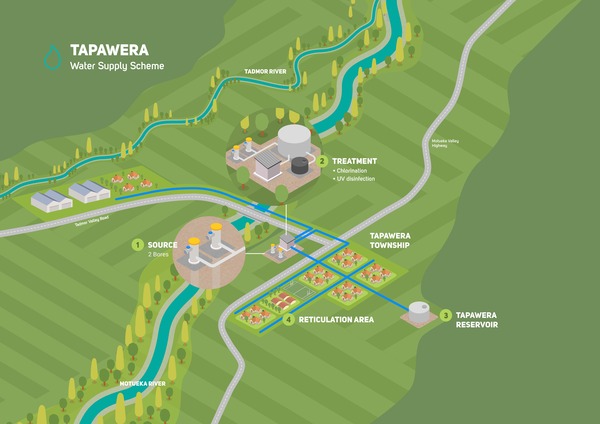
Diagram of the Tapawera water supply
Tapawera Water Supply takes water from two bores close to the Motueka River.
The water is chlorinated and UV treated for disinfection purposes.
| Parameter | Concentration | Units |
|---|---|---|
|
pH |
6.5 |
|
|
Turbidity (cloudiness) |
<0.2 |
NTU |
|
Hardness (total) |
69 |
mg/l as CaCO3 |
|
Calcium |
7.5 |
mg/l |
|
Magnesium |
11.9 |
mg/l |
|
Manganese |
<0.0005 |
mg/l |
|
Nitrate |
1.77 |
mg/l as Nitrate-Nitrogen |
|
NItrite |
<0.002 |
mg/l as Nitrite-Nitrogen |
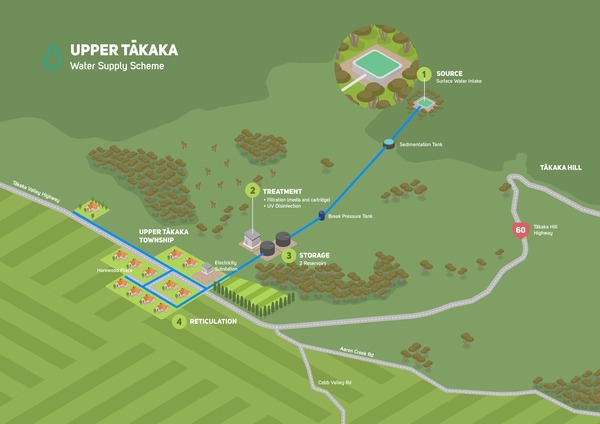
Diagram of the Upper Tākaka water supply
Upper Tākaka Water Supply takes water from a creek on Tākaka Hill.
The water undergoes sedimentation, filtration, and UV disinfection. Permanent chlorination of the supply was agreed by Council in May 2021 and will be introduced in due course.
Please contact us if you'd like more information on the Upper Tākaka supply.
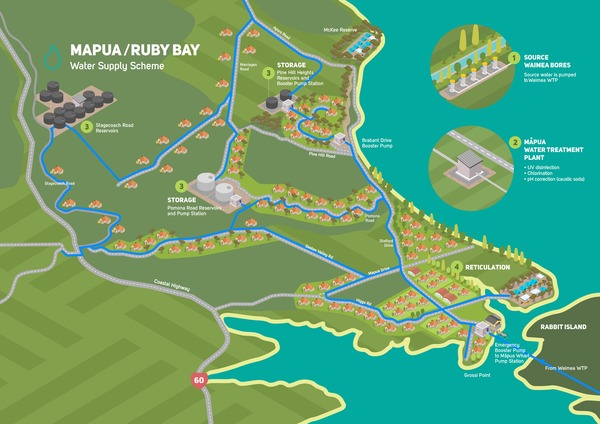
Diagram of the Māpua/Ruby Bay water supply
This supply covers the Māpua Urban area (mostly metered) and Ruby Bay rural area (mostly restrictors).
The zone extends from Old Coach Road at its westernmost point, to Permin Road, Tasman at its northern point.
Water is taken from bores, chlorinated for disinfection and pH corrected using lime.
| Parameter | Concentration | Units |
|---|---|---|
|
pH |
6.5 |
|
|
Turbidity (cloudiness) |
<0.1 |
NTU |
|
Hardness (total) |
Approx 70 |
mg/l as CaCO3 |
|
Calcium |
13 |
mg/l |
|
Magnesium |
8.7 |
mg/l |
|
Iron |
<0.002 |
mg/l |
|
Manganese |
<0.001 |
mg/l |
|
Nitrate |
0.6-1.8 |
mg/l as Nitrate-Nitrogen |
|
LSI |
-2.1 |
|
|
Sulphate |
6.8 |
mg/l |
|
Alkalinity |
56 |
mg/l |
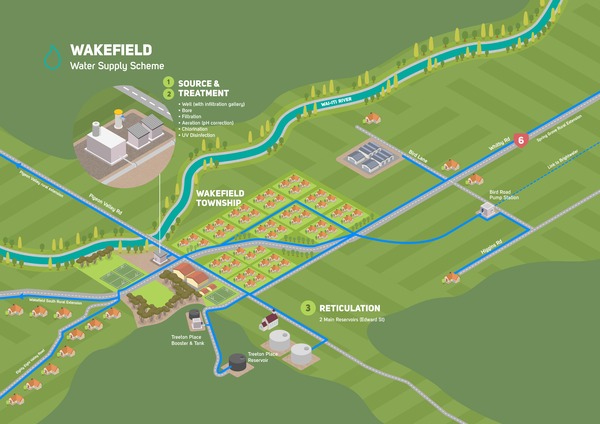
Diagram of the Wakefield water supply
The Wakefield water supply covers the urban Wakefield area, Pigeon Valley and extends along Main Road Spring Grove, as far as the Spring Grove church.
Water is taken from a shallow well and infiltration gallery close to the Wai-iti River in Wakefield.
The water is aerated for pH control and chlorinated for disinfection purposes.
The Waimea Water Strategy is included in the 2021-2031 Long Term Plan. It includes new and upgraded infrastructure including source, treamtent and reticulation to improve level of service and growth capacity to Wakefield and Brightwater
| Parameter | Concentration | Units |
|---|---|---|
|
pH |
6.5 |
|
|
Turbidity (cloudiness) |
<0.3 |
NTU |
|
Hardness (total) |
40 |
mg/l as CaCO3 |
|
Calcium |
10 |
mg/l |
|
Magnesium |
3.3 |
mg/l |
|
Manganese |
<0.0005 |
mg/l |
|
Nitrate |
2 |
mg/l as Nitrate-Nitrogen |
|
Nitrite |
<0.002 |
mg/l as Nitrite-Nitrogen |
Last modified: