Application Form - New water connection or change to water supply (pdf 681 KB)
If you are building or subdividing and you need to apply for a new connection to any of our water, stormwater or wastewater schemes, download and return the application form to [email protected].
You can also use this form for reducing water allocations or transferring units on rural schemes. For unit reductions or disconnections on our rural schemes or extension: applications need to be received before the end of May to ensure changes are completed before the financial year end (30 June), or another year of rates will be incurred.
Read the Water and Wastewater Connection Policy (pdf 185 KB), which guides Council practice in relation to water supply connections.
Learn how to manage your water meter; allowing you to monitor and control your water usage and detect leaks, which saves you money and our precious water resources.
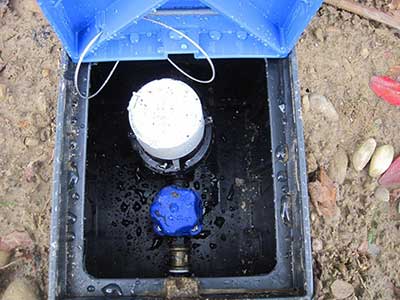
Water meters are usually located below ground level in a box near the road boundary of your section. There is a shut off valve in the meter box so you can turn your water off for any plumbing repairs.
It is a good idea to check your water meter regularly to ensure you have no leaks.
Reading the water meter is a simple task. There are eight numbers: The four on the left record whole cubic metres, the four on the right in bold record parts of a cubic metre (litres).
2 4 0 6 3 9 0 5 shows you have used 2406.3905 cubic metres (m3) of water. Put another way, you have used 2,406 cubic metres and 390.5 litres of water. A cubic metre equals 1,000 litres or 220 gallons.
When it comes to charging, only the black numbers (cubic metres) are read and will appear on your water account.
Water meter readings when you sell your house.
In order to prepare a final bill for the property you have sold, you should notify the Council for a final reading of your water meter when you move out. These special readings are done weekly and an extra charge applies. Also, remember to check that the meter is being read at the house you are moving into.
Old metal fittings in some water supplies can mean minute traces of lead may be present in your household tap water.
Research carried out by the Institute of Environmental Science and the Ministry of Health has shown that some New Zealand water supplies contain minute traces of lead that are near to or exceed the maximum acceptable level specified in the New Zealand Drinking Water Standards. Traces of metals - in particular lead - are of concern because over time they pose a potential health risk, especially if consumed from childhood.
It is important to note that the lead is not coming from the water supplies themselves, but primarily from metals in some household fittings that may be dissolved into the water. The amount of lead that will dissolve from a fitting depends on how plumbosolvent* the water is; the temperature of the water; the composition of the plumbing fittings and how long the water has been in contact with it.
The fact that most New Zealand waters are of very good quality and contain little dissolved substances such as calcium and magnesium salts contributes to their plumbosolvency, which is widespread in New Zealand. The Ministry of Health therefore recommends that people do not drink the first mugful of water if their tap has not been used for several hours ie, overnight for instance.
Instead, people should run the tap for a second or so, which will quickly flush away any water that has become contaminated with lead or any other metals from the plumbing fittings. If you’ve been away for a while, flush a toilet or run the shower for a minute or two to remove water with metals in it.
The Ministry of Health works closely with Standards New Zealand and the plumbing industry in New Zealand to develop quality standards for plumbing fittings.
Additional details on this issue can be sourced from the Taumata Arowai website.
* plumbsolvent = The types of water that have the ability to dissolve lead (usually soft waters) are known as ‘plumbsolvent’ because of their ability to dissolve lead (from the Latin word plumbum).
In an emergency, you can hand-chlorinate private drinking water tanks.
You can hand chlorinate your water tanks with household bleach if they become contaminated/receive untreated water.
You should use plain, non-fragranced non-coloured bleach, ideally one which has no added agents.
Budget plain household bleach and Chlor-o-gene are two brands that are suitable. Janola does have added chemicals, but can still be used in an emergency.
The table below shows how much chlorine you should add to a tank full of water. The dose is in ml (millilitres) and so can be measured using a kitchen measuring jug. Wear rubber gloves when dosing chlorine.
Chlorine will not kill protozoa, which is a risk posed by sewage contamination. If in any doubt, boil your water before drinking until you are certain it’s safe to use. Once the chlorine has been added, wait 30 mins to allow the chlorine to react and mix, then draw chlorinated water through the house by running taps.
Note: 1ppm is the same as 1mg/l (milligram per litre) and also 1g/m3 (gram per cubic metre)
|
Tank size in litres (m3 in brackets) |
ml of household bleach to reach 1ppm |
ml of household bleach to reach 2ppm |
ml of household bleach to reach 10ppm |
|
1000 (1) |
33 |
67 |
333 |
|
5000 (5) |
167 |
333 |
1,667 |
|
10,000 (10) |
333 |
667 |
3,333 |
|
20,000 (20) |
667 |
1,334 |
6,667 |
|
25,000 (25) |
834 |
1,668 |
8,334 |
|
30,000 (30) |
1,000 |
2,000 |
10,000 |
For example, if a bottle of chlorine is 500ml, and you need to dose to 2ppm in a 30,000l tank, that will be 4 bottles of bleach.
Dovedale water supply is under a Permanent Boil Water Notice.
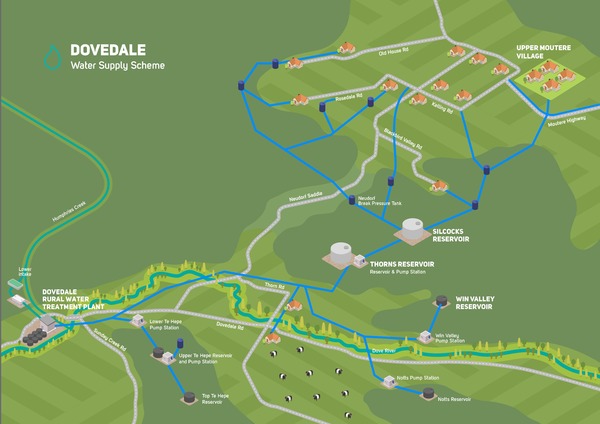
The Dovedale water supply is a rural network supply that provides drinking water for households as well as water for stock and irrigation across the Dovedale area, Upper Moutere, and Rosedale Road.
The network is large, rural, steep hilly and rugged terrain over an area of approximately 12,000 hectares and with approximately 145km of pipe reticulation. The area is dependent on pumping so there are multiple pump stations and water storage tanks, including break‑pressure tanks.
The water is supplied into property owners’ storage tanks as a constant trickle flow through a restrictor valve sized for the required number of water units. Customers are required to have three days on-site storage under the Councils bylaw and recommended to have seven days of storage to provide for water in case of pipe bursts, etc.
Water is sourced from a weir in Humphries Creek, a tributary of the Dove River.
The Dovedale Water Treatment Plant processes include –
Water is chlorinated to protect against bacteria (such as E. coli) and this also provides some ongoing protection throughout the distribution network in case any contamination occurs after treatment.
The plant operates continuously to maintain network pressure, ensure a reliable supply to properties and minimise wear and tear on essential equipment such as pumps. However, the water supply—or parts of the network – is susceptible to temporary shutdowns, most commonly due to pipe bursts.
A permanent boil water notice is in place because there is no protozoa (including Giardia and Cryptosporidium) treatment in place and the quality of the source water varies significantly, making it difficult to consistently treat using chlorine alone.
The water source is vulnerable to weather conditions within the catchment’s steep terrain. During heavy rainfall, turbidity (cloudiness) and sediment levels increase in the water entering the treatment plant. While larger particles are removed in the sediment tank, finer sediment can pass through the treatment process and into the distribution network.
This fine sediment can cause operational issues, including pump wear, pipe blockages, and sediment settling in storage tanks. High turbidity water can also shield microorganisms from disinfection and significantly increase chlorine demand, making it harder to effectively treat the water and can lead to the creation of disinfection by-products.
Prolonged dry weather spells can reduce creek flows and at times, the Council may ask the community to conserve water.
Water is tested for bacteria and different chemicals in the raw water entering the treatment plant, in the treated water leaving the plant and set locations in the distribution network.
The table shows the standard, median or range of values for some source water parameters, in comparison to the maximum acceptable values set in the Drinking Water Standards for New Zealand (DWSNZ MAV) and aesthetic values.
Samples are taken at the treatment plant before treatment, so the results reflect water from the stream source and the raw water pipeline to the plant.
|
Parameter |
Value |
DWSNZ MAV |
Aesthetic Value |
Units |
|
pH |
7.23 |
|
7 - 8.5 |
pH |
|
Turbidity |
1.62 – 98.7 (range) 4.1 (Median) |
|
≤ 5 (appearance) |
ntu |
|
Iron |
0.151 – 3.6 |
|
≤ 0.3(staining) |
mg/L |
|
Manganese |
0.0077 - 0.149 |
0.4 |
≤ 0.04(staining) ≤ 0.10 (taste) |
mg/L |
|
Nitrate |
0.096-0.83 |
11.3 |
|
mg/L as NO3-N
|
|
Arsenic |
< 0.0011 |
0.01 |
|
mg/L |
Water quality is checked for various parameters at set locations across the network. The table shows the standard, median or range of values for some source water parameters, in comparison to the maximum acceptable values set in the Drinking Water Standards (DWSNZ MAV) and aesthetic values.
Water samples are taken from sites close to the main pipeline, meaning the water quality at your tap may be different because of storage tanks and home pipes and fittings.
|
Parameter |
Value |
DWSNZ MAV |
Aesthetic Value |
Units |
|
|
Bacteria (E. coli) |
<1 |
< 1 |
|
MPN/100ml |
|
|
Bacteria (Total coliforms) |
<1 - >201 |
|
|
MPN/100ml |
|
|
Chlorine (FAC) |
0 - 3 (range) 0.8 (median) |
5 |
0.3 – 1.0 (taste/odour) |
mg/L |
|
|
Antimony |
< 0.00021 |
0.02 |
|
mg/L |
|
|
Cadmium |
< 0.000053 |
0.004 |
|
mg/L |
|
|
Chromium |
< 0.00053 |
0.05 |
|
mg/L |
|
|
Copper |
0.0034 - 0.0059 |
|
≤1 (staining) |
mg/L |
|
|
Lead |
< 0.00011- 0.00065 |
0.01 |
|
mg/L |
|
|
Mercury |
< 0.00008 - < 0.00011 |
0.007 |
|
mg/L |
|
|
Nickel |
< 0.00053 |
0.08 |
|
mg/L |
|
Laboratory testing of the treated water in the network shows that one disinfection by-product (DBP) – Dichloroacetic acid – continues to be elevated on occasions to just above the Maximum Acceptable Value (MAV) specified in the Drinking Water Standards for New Zealand.
When source waters like Dovedale’s have higher levels of turbidity (due to the presence of organic matter), DBP’s may be produced because of the interaction between the chlorine, which is the disinfectant, and the organic matter. The World Health Organisation is clear that controlling disinfection by‑products is important, but not at the expense of disinfection. Council needs to continue using chlorine to reduce the very real risk of illness‑causing bacteria in this water.
Further information on DBP’s and other chlorine-related issues can be found on the Water Services Authority – Taumata Arowai, website - Chlorine | Taumata Arowai.
Because of the water quality and quantity issues described above, Council is investigating a different and higher quality source water for Dovedale. We continue to conduct source yield and water quality investigations on test bores and depending on the outcome, we plan to implement a new source and upgraded treatment within approximately three years (2029).
There is now a permanent boil water notice in place on this supply. Read more here.
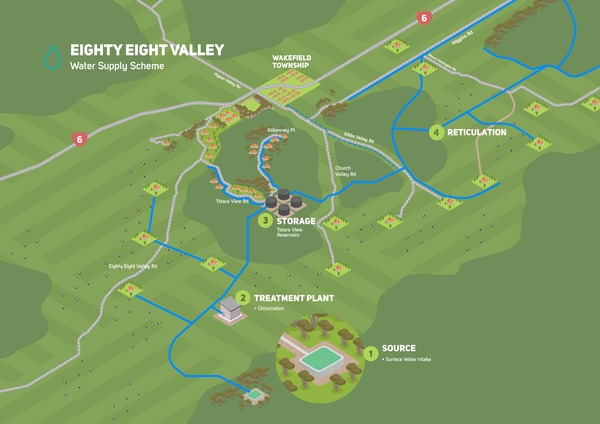
Eighty-Eight Valley Rural Water supply takes water from a creek close to the southern end of Eighty-Eight Valley Road.
Water is supplied to the rural 88 Valley Road area and as far north as Mount Heslington Road.
The water has coarse filtration and then is chlorinated.
Water is supplied entirely by restricted connections to private water tanks. No new units are being sold on this water supply.
| Parameter | Concentration | Units |
|---|---|---|
|
pH |
6.7 |
|
|
Turbidity (cloudiness) |
Generally <1 |
NTU |
|
Hardness (total) |
46 |
mg/l as CaCO3 |
|
Calcium |
12.5 |
mg/l |
|
Magnesium |
3.5 |
mg/l |
|
Manganese |
<0.0005 |
mg/l |
|
Nitrate |
0.03 |
mg/l as Nitrate-Nitrogen |
|
Nitrite |
<0.002 |
mg/l as Nitrite-Nitrogen |
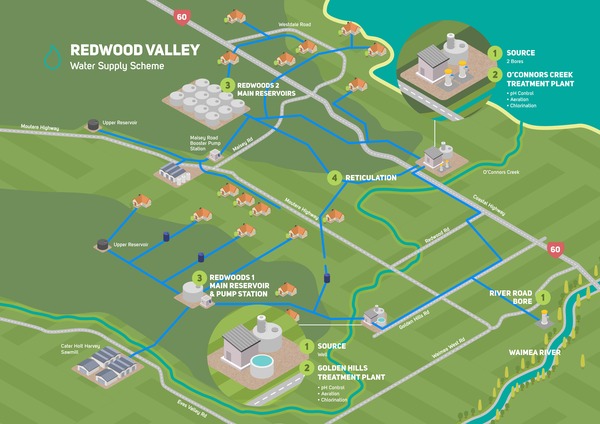
Diagram of the Redwood Valley rural water supply
There is a permanent boil water notice in place on this supply. Read more here.
Redwood Valley Rural Water Supply takes water from three shallow bores in the Redwood Valley/ Waimea plains area.
The water is aerated for pH control and then chlorinated for disinfection purposes.
There are currently no new units being sold on this supply.
| Parameter | Concentration | Units |
|---|---|---|
|
pH |
6.2 |
|
|
Turbidity (cloudiness) |
<1 |
NTU |
|
Hardness (total) |
56 |
mg/l as CaCO3 |
|
Calcium |
7.8 |
mg/l |
|
Magnesium |
8.8 |
mg/l |
|
Manganese* |
0.003 to 0.56 |
mg/l |
|
Aluminium |
0.010 |
mg/l |
|
Alkalinity |
46 |
mg/l as CaCO3 |
|
Copper |
0.001 |
mg/l |
|
Chloride |
15 |
mg/l |
|
Iron * |
<0.002 to 0.9 |
mg/l |
|
Lead |
<0.003 |
mg/l |
|
Sodium |
13 |
mg/l |
|
Sulphate |
14 |
mg/l |
|
Nitrate |
0.7 |
mg/l as Nitrate-Nitrogen |
(*treated water and raw water respectively)
The following areas are serviced by the Tasman District Council water schemes:
* Note there is currently a moratorium on new connections to the Eighty-Eight Valley and Redwood Valley rural water schemes.
## Note there is a permanent "Boil Water" requirement for the Dovedale Rural Water Scheme
Outside of the areas serviced by the Council's water supplies, the taking and use of water for households, stock drinking and firefighting uses is often a permitted activity and no consent is required provided certain rules are met.
Where larger rates of water take are proposed, including for irrigation, a resource consent will be required. This includes water from dams and bores.