All schools have 30km/h variable speed signs outside their gates. These limits apply for 45 minutes before and after the morning and afternoon school bells, in line with the Setting of Speed Limits Rule.
The only exceptions are:
Slow down around school buses
Park smarter around schools
Help us create a safer environment around your kura - for all ākonga (students), mātua (parents) and kaimahi (staff) travelling to and from school.
Drop-offs and pick-ups are busy for everyone, but there are lots of ways you can minimise traffic and stress, and help keep everyone safe.
Here are some ideas:
Remember
Breaking these rules can result in a fine.
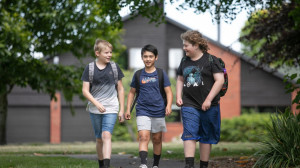 Walking school buses not only help ease congestion at the school gate but also help connect tamariki with their school community.
Here's how it works
Children are collected from stops along a planned route and safely dropped off at the school gate.
The Walking School Bus can operate any day of the school week, from just one day to all five, and can be in the morning, after school, or both, depending on the availability of adult volunteers and what works best for your team of bus drivers.
These resources developed by Christchurch City Council explain more:
Pledge and parent consent form
The walking school bus pledge is a tool we provide parents to help manage kids' behaviour on the walking school bus.
Each parent signs when their child/children join a walking school bus, agreeing to follow the road safety rules and to listen to the conductor's instructions.
Let's make walking to school a fun adventure.
Classroom ready resources to help teachers promote active travel and road safety practices are available on NZ Transport Agency’s Education Portal: Education Portal - All updates | Education Portal
Whether your family’s young people walk, bike, scoot or skate, it’s vital that everyone remains safe on their journey to and from school.
We’ve received recent reports of accidents and near misses at busy times before and after school.
Whether it’s walking, biking, scooting, taking the bus, or going by car, there are plenty of great ways for tamariki to get around. Some simple tips will help keep their journeys safe and stress-free, and most of them are common sense.
In the car, children should always wait for the car to stop completely before getting in or out on the footpath side if possible. They should sit in the back seat and avoid distracting the driver, and make sure car seats are fitted properly.
Young people who travel by bus should stand back from the road while waiting, and only board or exit once the bus has stopped. They should stay seated, keep their bags on their lap, and wait for the bus to leave before crossing the road.
Walking and cycling have their own challenges. It’s best that you walk facing traffic, use crossings and signals, and remember the kerb drill: stop, look, listen, think. Ideally, cyclists under the age of 10 should ride with an adult, keep left, signal clearly, and always wear a helmet.
... And don’t forget, whether biking, scooting, or skating – helmets must be worn. They should be in good condition, fit well, and have working straps and buckles.
Let’s work together to keep our tamariki safe on their daily adventures.
Always make sure your child is safely restrained when travelling in a vehicle. Here are some tips:
To find more information on child restraints, check out the following websites;
A school travel plan looks at the journey to and from school for children and their families.
This includes any road safety issues they may encounter on these journeys regardless of their mode of transport. The school travel plan will look at ways to reduce the safety issues.
It will also look at how to ease congestion around the school gate by encouraging more children and their families to walk, cycle or scooter to and from school.
The school travel plan is developed by the school, its community, the NZ Police and the council through the Road Safety Coordinator. Everyone works with the school to resolve any pressing issues e.g. congestion at the school gate and putting a safe programme into action. Each plan is tailored to meet the needs of a particular school. The end result generates a solution that is owned by the school, the wider school community and is supported by the Council.
If you feel that your school or your child's school has an issue regarding safe journeys to school, please talk to the staff at the school in the first instance. Then, either the Principal, the Board of Trustees or you can contact the Road Safety Coordinator at the Council.
Feet First is a joint initiative between Waka Kotahi NZ Transport Agency and NZ Government which promotes safe active travel to and from school
For any further information contact the Road Safety Coordinator.
Last modified: