Such was the interest in this sub-alpine area inland from the Moutere that all the sections offered were sold in one day. The prices paid were high for the times at 10-20 shillings per acre.
The Dovedale School, built in 1869, is still on its original site and today it provides classes up to year 8. Dovedale’s industries include forestry and mixed farming.
Dovedale water supply is under a Permanent Boil Water Notice.
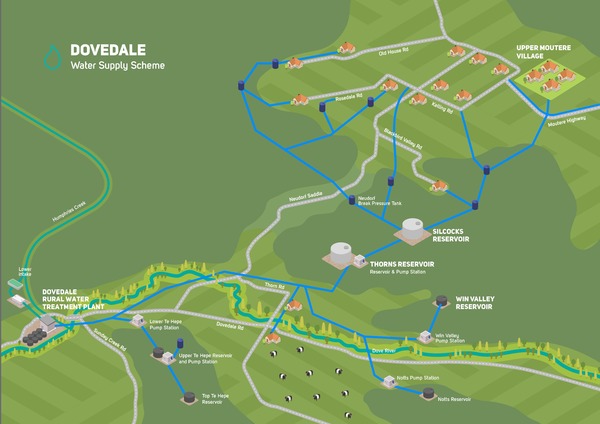
The Dovedale water supply is a rural network supply that provides drinking water for households as well as water for stock and irrigation across the Dovedale area, Upper Moutere, and Rosedale Road.
The network is large, rural, steep hilly and rugged terrain over an area of approximately 12,000 hectares and with approximately 145km of pipe reticulation. The area is dependent on pumping so there are multiple pump stations and water storage tanks, including break‑pressure tanks.
The water is supplied into property owners’ storage tanks as a constant trickle flow through a restrictor valve sized for the required number of water units. Customers are required to have three days on-site storage under the Councils bylaw and recommended to have seven days of storage to provide for water in case of pipe bursts, etc.
Water is sourced from a weir in Humphries Creek, a tributary of the Dove River.
The Dovedale Water Treatment Plant processes include –
Water is chlorinated to protect against bacteria (such as E. coli) and this also provides some ongoing protection throughout the distribution network in case any contamination occurs after treatment.
The plant operates continuously to maintain network pressure, ensure a reliable supply to properties and minimise wear and tear on essential equipment such as pumps. However, the water supply—or parts of the network – is susceptible to temporary shutdowns, most commonly due to pipe bursts.
A permanent boil water notice is in place because there is no protozoa (including Giardia and Cryptosporidium) treatment in place and the quality of the source water varies significantly, making it difficult to consistently treat using chlorine alone.
The water source is vulnerable to weather conditions within the catchment’s steep terrain. During heavy rainfall, turbidity (cloudiness) and sediment levels increase in the water entering the treatment plant. While larger particles are removed in the sediment tank, finer sediment can pass through the treatment process and into the distribution network.
This fine sediment can cause operational issues, including pump wear, pipe blockages, and sediment settling in storage tanks. High turbidity water can also shield microorganisms from disinfection and significantly increase chlorine demand, making it harder to effectively treat the water and can lead to the creation of disinfection by-products.
Prolonged dry weather spells can reduce creek flows and at times, the Council may ask the community to conserve water.
Water is tested for bacteria and different chemicals in the raw water entering the treatment plant, in the treated water leaving the plant and set locations in the distribution network.
The table shows the standard, median or range of values for some source water parameters, in comparison to the maximum acceptable values set in the Drinking Water Standards for New Zealand (DWSNZ MAV) and aesthetic values.
Samples are taken at the treatment plant before treatment, so the results reflect water from the stream source and the raw water pipeline to the plant.
|
Parameter |
Value |
DWSNZ MAV |
Aesthetic Value |
Units |
|
pH |
7.23 |
|
7 - 8.5 |
pH |
|
Turbidity |
1.62 – 98.7 (range) 4.1 (Median) |
|
≤ 5 (appearance) |
ntu |
|
Iron |
0.151 – 3.6 |
|
≤ 0.3(staining) |
mg/L |
|
Manganese |
0.0077 - 0.149 |
0.4 |
≤ 0.04(staining) ≤ 0.10 (taste) |
mg/L |
|
Nitrate |
0.096-0.83 |
11.3 |
|
mg/L as NO3-N
|
|
Arsenic |
< 0.0011 |
0.01 |
|
mg/L |
Water quality is checked for various parameters at set locations across the network. The table shows the standard, median or range of values for some source water parameters, in comparison to the maximum acceptable values set in the Drinking Water Standards (DWSNZ MAV) and aesthetic values.
Water samples are taken from sites close to the main pipeline, meaning the water quality at your tap may be different because of storage tanks and home pipes and fittings.
|
Parameter |
Value |
DWSNZ MAV |
Aesthetic Value |
Units |
|
|
Bacteria (E. coli) |
<1 |
< 1 |
|
MPN/100ml |
|
|
Bacteria (Total coliforms) |
<1 - >201 |
|
|
MPN/100ml |
|
|
Chlorine (FAC) |
0 - 3 (range) 0.8 (median) |
5 |
0.3 – 1.0 (taste/odour) |
mg/L |
|
|
Antimony |
< 0.00021 |
0.02 |
|
mg/L |
|
|
Cadmium |
< 0.000053 |
0.004 |
|
mg/L |
|
|
Chromium |
< 0.00053 |
0.05 |
|
mg/L |
|
|
Copper |
0.0034 - 0.0059 |
|
≤1 (staining) |
mg/L |
|
|
Lead |
< 0.00011- 0.00065 |
0.01 |
|
mg/L |
|
|
Mercury |
< 0.00008 - < 0.00011 |
0.007 |
|
mg/L |
|
|
Nickel |
< 0.00053 |
0.08 |
|
mg/L |
|
Laboratory testing of the treated water in the network shows that one disinfection by-product (DBP) – Dichloroacetic acid – continues to be elevated on occasions to just above the Maximum Acceptable Value (MAV) specified in the Drinking Water Standards for New Zealand.
When source waters like Dovedale’s have higher levels of turbidity (due to the presence of organic matter), DBP’s may be produced because of the interaction between the chlorine, which is the disinfectant, and the organic matter. The World Health Organisation is clear that controlling disinfection by‑products is important, but not at the expense of disinfection. Council needs to continue using chlorine to reduce the very real risk of illness‑causing bacteria in this water.
Further information on DBP’s and other chlorine-related issues can be found on the Water Services Authority – Taumata Arowai, website - Chlorine | Taumata Arowai.
Because of the water quality and quantity issues described above, Council is investigating a different and higher quality source water for Dovedale. We continue to conduct source yield and water quality investigations on test bores and depending on the outcome, we plan to implement a new source and upgraded treatment within approximately three years (2029).

Committees
Joint Committees of Nelson and Tasman Councils
Other Committees
Phone: 027 538 4384
Email: [email protected]

Committees
Joint Committees of Nelson and Tasman Councils
Other Committees
Contact details
Email: [email protected]

Committees
Subcommittees
Joint Committees of Nelson and Tasman Councils
Other Committees
Phone: 022 177 1172
Email: [email protected]