In 2021, we started on the journey to restore Teapot Valley in the aftermath of the Pigeon Valley fire. Our work focused on hillslope areas where the forest was most affected by the fire, and on weed-dominated riparian and wetland areas.
The primary aim of the project was to begin restoring forest and wetland communities, particularly by increasing connections between remnants through replanting and weed control.
As the project wraps up, Project Manager Fiona Ede is happy with what has been achieved, and excited about the extensive natural regeneration of native species across the site that will support the ongoing restoration of Teapot Valley over the coming decades.
Through these restoration efforts, we have improved ecosystem health and resilience across the area.
Forested gullies once separated by burnt hillslopes are now reconnected through planting and natural regeneration of native species, while intact forest remnants have been protected by removing large old man’s beard vines.
Riparian areas have been cleared of large exotic trees and replanted with native species. And, in wetlands, areas cleared of weeds are now flourishing with native species.
The project also collected a lot of information about restoration outcomes is available to download below.
We recently presented the findings and achievements of the project in a webinar - you can watch it below or via our YouTube channel link here.
Whatever you’ve made of summer so far – it has certainly been good for growing plants, particularly at our Teapot Valley restoration project site.
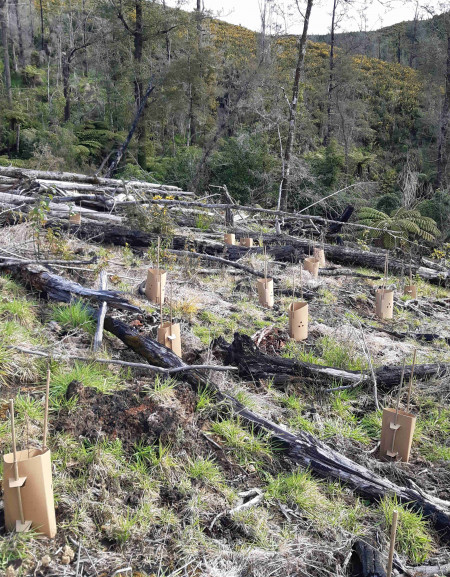
We have planted more than 33,000 native trees, shrubs and wetland plants across 11 hectares over the past three years, and many of the older plantings are now very well established.
One of the main aims of the replanting programme was to increase the ecological resilience of the site by reconnecting hillslope areas burnt in 2019 fires with existing patches of forest in gullies and the stream valley.
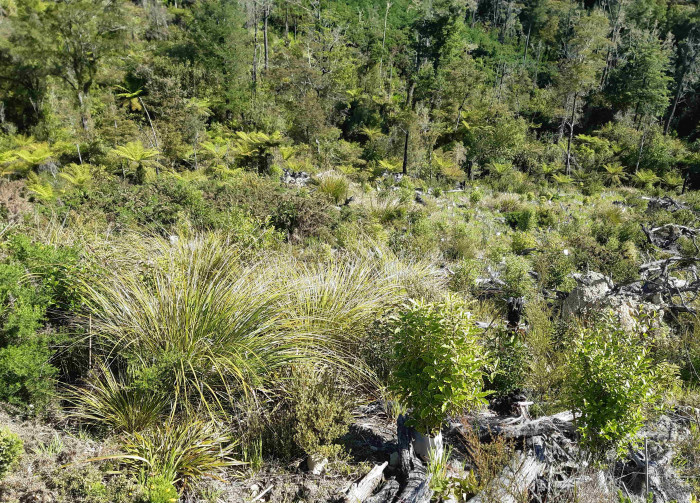
An example of the reconnections taking place can be found in an area planted in 2022 at the western end, with many of the planted trees and shrubs now more than two metres tall.
This establishment, coupled with the natural regeneration of other native species, including tall sedges, means that an area previously dominated by weedy grasses and gorse is well on its way to becoming a flourishing native forest once more.
Another pleasing aspect of the project has been the opportunity to experiment with new ideas and to learn from taking an experimental approach to restoration. In 2023, we ran a small direct seeding trial, sowing 12 species of native shrubs.
The dry conditions throughout the growing season limited seedling establishment, but we did get several karamū (Coprosma species) and mānuka plants establishing.
We repeated the experiment in 2024, and the wetter conditions over spring helped almost 3,000 seedlings emerge, so the recent summer rain has been very welcome.
We’re continuing to improve the health of the native forest communities and learning plenty as we restore areas burnt in the Pigeon Valley fire.
Last winter, contractors planted 14,000 native trees, shrubs and wetland plants at our Teapot Valley sites. These plants are healthy and flourishing, with 96% of them surviving this first growing season.
The 2023 planting season is already underway, with another 13,000 trees and shrubs being planted. We are planting a more diverse mix of species this year to reconnect patches of forest that provide additional and more resilient habitats for native birds and fauna.
Direct seeding is another revegetation technique that can be more cost-effective than planting and can be done on a larger scale. We are experimenting with direct seeding in Teapot Valley, testing the effectiveness of directly sowing seed of pioneer shrub species into plots later this winter.
Given that New Zealand forest species are not well-adapted to fire, an interesting component of this project is understanding how well native vegetation has responded after the fire.
To monitor natural regeneration after fire, we’ve set up a number of plots across the most fire-affected parts of the site.
Assessing the plots in summer 2023, four years after the fire, we found high levels of natural regeneration across a diversity of native tree and shrub species, from tiny seedlings to plants more than two metres tall.
This project is supported by MPI’s One Billion Trees programme and Tasman Pine Forests Ltd.
Three years after the fire that devastated the Teapot Valley hillside, restoration is well underway.
Funded by MPI’s Billion Trees programme, our four-year Jobs for Nature project aims to restore fire-affected hillslopes that were burnt in the 2019 Pigeon Valley fire, as well as re-connecting remnants of alluvial forest along Teapot Valley Stream.
The restoration site covers around 60 ha, including several areas of intact forest in good condition, hosting a diversity of plant and bird species.
Other areas of the site have more limited native vegetation, but some natural regeneration is occurring which will be supplemented with in-fill planting to increase plant diversity and abundance.
In areas most impacted by the fire, full revegetation is required, with 16,000 native plants on order for planting this winter and another 17,000 plants in winter 2023. As well, some experimental direct seeding will be carried out, with native seed introduced to areas cleared of weeds. If successful, direct seeding provides a cost-effective complement to planting, particularly over large areas.
Weed control in the site started in mid-2021 and will continue throughout the project.
Project manager Fiona Ede says that the ongoing support of landowner, Tasman Pine Forests Limited, has been instrumental in getting the project underway, and she is excited about what the project will achieve.
“This is a great opportunity to learn how fire-affected vegetation communities recover and how we can accelerate their recovery through planting, direct seeding and effective weed control promoting natural regeneration.”
Fiona and her team have also been monitoring the existing vegetation, which will be done again at the end of the project.
Fiona says comparing before and after data will provide valuable insights into the effectiveness of the restoration activities.
A collaborative effort to regenerate damaged landscape from New Zealand’s largest wildfire is about to begin with the help of a $1 million funding boost.
Tasman District Council has received just under $1 million from Te Uru Rākau – New Zealand Forest Service for its Teapot Valley/Pigeon Valley fire restoration project, with landowners Tasman Pine Forests Ltd contributing another $70,000 in cash and resources to the project.
This project will run over a four-year period as part of Government stimulus funding through the One Billion Trees and Jobs for Nature programmes.
The Pigeon Valley fire started on 5 February 2019 and burnt through an area of approximately 2,400 hectares (ha) in the Tasman district.
Of the total area burnt, 1400 ha was plantation pine forest managed by Tasman Pine Forests Ltd.
Patches of native bush and wetland areas within the pine plantation were also affected.
It is proposed that three sites within the Teapot Valley catchment, identified by Tasman District Council as Significant Natural Areas (SNAs), will be restored in this project through a mixture of weed control, replanting in around 10 ha of the area, as well as direct seeding.
The Council’s contract manager for the project Paul Sheldon said it was exciting to begin a new phase in the disaster recovery but also to develop techniques for future restorations in an unstable climate future.
“I think we’ve lost a lot through the fires in terms of disruptions and losses and now we’re trying to recover and enhance what we can.”
The aim is to work with the natural regeneration as much as possible, bringing back native vegetation where necessary and assisting with the ecological values of the area by developing some riparian and wetland planting.
A project manager has been appointed and a restoration plan of the area was being developed through the Council’s Jobs for Nature Supply Panel.
Preliminary plant orders are in the process of being secured.
Based in Wakefield, where a number of evacuations took place during the fires, Tasman Pine Forests Limited (TPFL) manages around 36,600 ha of forest plantations throughout Te Tauihu.
TPFL chief operating officer Steve Chandler said “we are supporting the Teapot Valley native restoration project with a $40,000 cash contribution for purchase of tree seedlings and $30,000 of in-kind contribution for felling of dead burnt spars (trees), weed control and boundary access during the four-year project period”.
“We look forward to working with TDC to achieve a successful restoration of the project area."
Last modified: