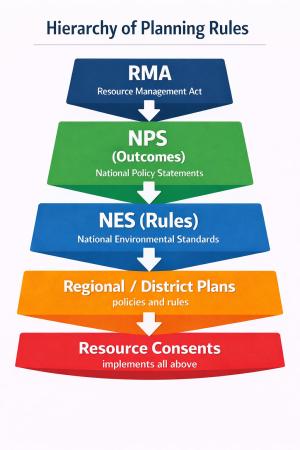
On 15 January 2026, the Government released 10 National Policy Statements (NPS) and National Environmental Standards (NES) under the Resource Management Act (RMA).
These national rules and policies guide how councils like Tasman plan for growth, protect the environment, and make resource consent decisions.
Together, they ensure planning and environmental decisions are consistent across New Zealand.
Homeowners can now build a small self‑contained unit (up to 70 m²) without needing a resource consent, as long as they meet national criteria for building size, location, and setbacks.
This applies in most urban, rural, mixed‑use and Māori‑purpose zones.
What it means for Tasman:
New pathway for small homes or “granny flats”, creating more affordable and flexible housing options. Council will now use consistent national standards when assessing these proposals.
Please refer to this helpful information and step by step process to guide you through it.
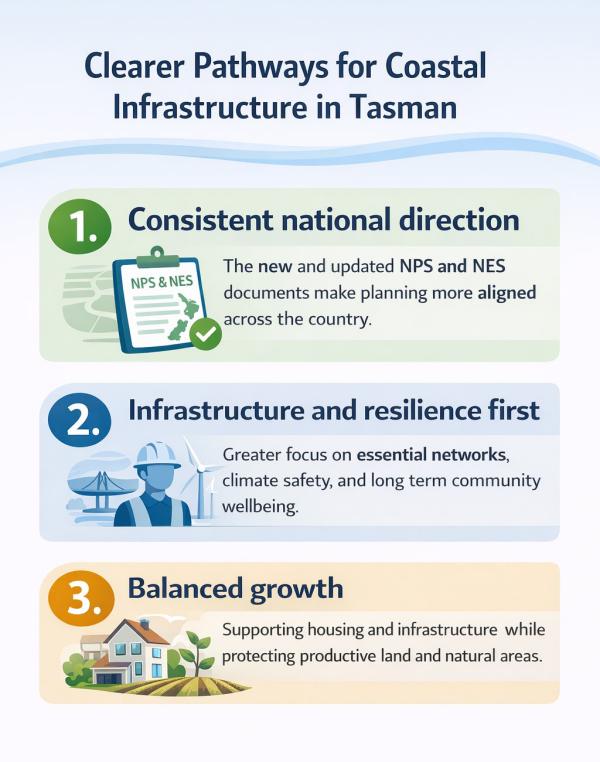
Infrastructure is now recognised as a matter of national importance. Councils must give more weight to essential services — roads, water supply, wastewater, and flood protection — when making decisions.
What it means for Tasman:
This shift supports planning for growth in areas such as Richmond, Motueka, Māpua, Brightwater and Wakefield, and helps manage risks from floods, coastal hazards and severe weather. It links long‑term planning with investment in infrastructure and community safety.
Councils must take a risk‑based, consistent approach to hazards like flooding, erosion and landslips. Development should be avoided in high‑risk areas, and long‑term adaptation must be built into plans.
What it means for Tasman:
Expect closer attention to flood and coastal risk when applying for resource consent or proposing plan changes, and earlier conversations about resilience measures with landowners and developers.
The Policy for managing productive land has been made more flexible, especially for Class 3 soils. Strong protections remain for the most valuable Class 1 and 2 soils.
What does this mean for Tasman:
Council will review its mapping and plan rules to reflect this new direction. The goal is to balance food production with future housing and infrastructure needs, using land efficiently and protecting top‑quality soils.
 5. New Zealand Coastal Policy Statement Amendment 2025
Policy updates make it easier to enable priority activities such as infrastructure, renewable energy and aquaculture in the coastal environment where these activities have a functional need to be there.
The 2025 amendments to the New Zealand Coastal Policy Statement, alongside related updates to national environmental standards and policy statements, collectively prioritise enabling functional coastal activities like infrastructure, renewable energy, aquaculture, electricity networks and quarrying through clearer, more consistent consenting pathways, while reinforcing protections for natural character, ecosystems, biodiversity and hazard resilience—for Tasman, this demands proactive alignment of TRMP coastal provisions, Port Tarakohe planning and hazard strategies to unlock economic opportunities without eroding the region's landscape values or tourism appeal.
Policy wording has been refined to improve clarity and consistency for activities like quarrying and mining, while maintaining strong protection for native plants and animals.
The freshwater policies strengthen and clarify how functional and operational needs are to be considered when managing activities that interact with freshwater.
The NPS-FM now more clearly recognises that some activities, such as infrastructure, quarrying, aggregate extraction, network utilities and regionally important operations—have a genuine need to be located in, on, or near freshwater bodies in order to function effectively or safely. Decision-makers must acknowledge these needs when assessing proposals, alongside freshwater values and environmental limits.
This does not remove environmental bottom lines or Te Mana o te Wai, but it does require a more balanced and realistic assessment, ensuring that activities with unavoidable freshwater interactions are not automatically precluded where effects can be appropriately managed. The amendment aims to reduce inconsistency and duplication across national direction, provide clearer consent pathways, and support nationally and regionally important activities while still protecting freshwater ecosystems.
These updates align freshwater rules with the new policy direction and make consenting requirements clearer and more consistent, especially for activities like earthworks and discharges.
Clearer direction to support renewable energy projects, including upgrading and re‑consenting existing generation while managing environmental effects.
Stronger national guidance for maintaining and expanding electricity networks to support reliable, resilient power across regions.
From 15 January 2026, most resource consents due to expire before the end of 2027 are automatically extended to 31 December 2027. This avoids unnecessary re‑applications during the transition period to the new planning system.
Some exceptions apply — especially for water‑related consents. All original consent conditions remain in force.
Last modified: