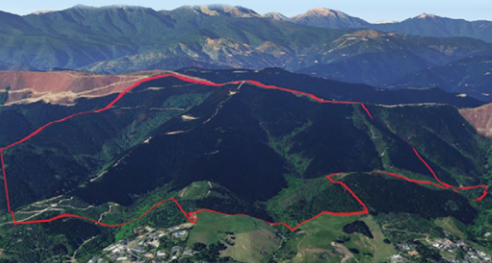
We will be replanting the Forest in a mix of native and permanent exotic trees, and improve the recreational tracks. This will be done over the next 20 years as we gradually retire from commericial forestry operations to focus on recreational usage.
The Forest was renamed Kingsland Forest Park to signify the change from a commercial forest to a recreational area. The Kingsland name acknowledges the efforts of Henry and Tom Kingsland, father and son, who were involved in the pine industry in Richmond from the 1920s.
Check out the wayfinding map for Kingsland Forest Park (pdf 4.4 MB). This signage also appears in places on the trails.
Alternatively, you can view the network of tracks in our region on the Outdoor Access maps(external link). Switch on the Tracks and Trails layer and zoom in on our region to check them out.
On 2nd July 2020, Tasman District Councillors adopted the Development Plan.
Read the Plan here: Kingsland Forest Park Development Plan (pdf 2.2 MB)
Appendices: Kingsland Forest Park Development Plan Appendices (pdf 1.3 MB)
Despite the wet weather and inclement conditions, our 2025 planting season at Kingsland Forest Park was completed in September, thanks to the tireless efforts of contractors and volunteers.
This winter, we have managed to put a mammoth 38,500 native plants in the ground, which means we have now planted the vast majority of areas that have been harvested since development began in 2020.
Volunteer group Keep Richmond Beautiful also assisted with planting around the Henry Road skid site.
A large programme of weed control will be the focus for the foreseeable future, with only smaller areas of planting remaining.
As with other parts of Tasman District, some areas of the Kingsland hillside were affected by the wild winter weather. This included clearing fallen trees over roads and mountain bike tracks, and clearing slips from roads and water tables in numerous locations.
Fortunately, we have been able to address most of the damage; however, one area in the forest is still closed due to fallen and unsafe trees. The Karearea Track is partly closed and will be for some time until the remainder of the macrocarpa stand can be safely removed.
The planting programme complements the wider work that we’re carrying out to improve the Kingsland hillside and its surrounds.
Getting Kingsland Forest to its present state has required many hours of effort from our kaimahi, contractors, plant nurseries, and
volunteers. Thanks to everyone who has supported the work so far.
A lot has been going on to improve Kingsland Forest and its surrounds recently. This work was rounded out nicely with some valuable additions, providing varying levels of emergency relief.
Contractors have done a fine job constructing two fire ponds on the Fowler and Henry Road Skids. The construction of both ponds is mostly finished, and they have started to fill with water.
Should the worst occur, the immediate availability of water in this location can make a critical difference in controlling and extinguishing fires before they spread.
As we’ve promised, a toilet has also been installed, which came from Better Off Funding. In the process of consulting on the Kingsland Forest Park Plan, a toilet at a central point in the forest was one of the most popular suggestions.
At peak times, from past track counters, more than 500 people per day are in the area – so there’s a reasonable need for a toilet.
You’ll find this comfort stop in between Big Skid and Fowler Road Skid.
Along with planting thousands of new trees to restore the aesthetic of the hillside behind Richmond, we installed three new park benches at the Fowler, Henry and Heaton Road Skid sites – with the help of volunteers from Keep Richmond Beautiful. A further 34,000 native trees will be planted in Kingsland Forest in 2025.
We have also installed 10 new way-finding signs at the main entranceways and strategic locations as well as rebuilt two mountain bike tracks.
Kingsland Forest is one of several forests that the Council owns to raise revenue and reduce the demand on rates. It is also the least profitable of the plantation forests the Council owns and manages. Harvest cycles impinge on recreational use of the area and on biodiversity. Harvesting can also present a downstream risk to the urban community of Richmond, particularly given the more frequent storms we are experiencing in the District.
Taking advantage of the harvesting cycle in 2020, the Council have planned to move away from commercial forestry behind Richmond, and manage the Forest solely as a recreational and biodiversity asset for Richmond.
Kingsland Forest covers about 100 hectares, most of which is planted with pinus radiata. A significant proportion of these trees are due to be harvested in the next few years. There are also pockets of native species within the forest that are being restored through additional planting and pest control by active and keen volunteers. The forest contains the ‘Barrington Gum’, a Eucalyptus regnans or mountain ash, which is reputed to be one of the tallest trees in New Zealand.
To create the Plan, we approached Te Tau Ihu iwi, adjacent landowners (including Silvan Forest owners), Nelson Mountain Bike Club, MTB Trails Trust, Forest & Bird, Keep Richmond Beautiful, Hill Street South Will's Gully Group, Native Bird Recovery Richmond, and Walking Access NZ.
During February and March 2019, we created an informal survey and made it available to users of the Forest, on our website, and promoted it on social media. This was to gauge how often and why people used the Forest, as well as what they envisioned for the future of the Forest.
The Council developed a draft development plan covering a wide range of issues for public consultation. The consultation period ran from 18 December 2019 until 6 March 2020. We held 5 drop in sessions during this time. There were 12 submitters who chose to speak to the Hearings Panel. Hearings were held on 16 March 2020, with deliberations delayed due to COVID-19 until the 2 June 2020.
We received 212 submissions.
Read all the submissions here: Spreadsheet of submissions for Draft Kingsland Forest Development Plan (pdf 19 MB)
Download the report and summary of the submissions here: Report to hearings 20-06-2020 (pdf, 2.1 MB)
Last modified: