

We have detected toxic algae levels in lakes in Western Golden Bay that could present a health risk to people and animals.
Our current advice is to be cautious around contacting toxic algae when it is present as scums or green/brown blooms or discolouration in the following lakes:
- Lake Whupa / Kaihoka Lake West (note: Lake Tinawhu / Kaihoka Lake East has not presented blooms to date as far as we are aware)
- Dune Lake (Wharariki Park)
- Island Lake (Wharariki Farm Park)
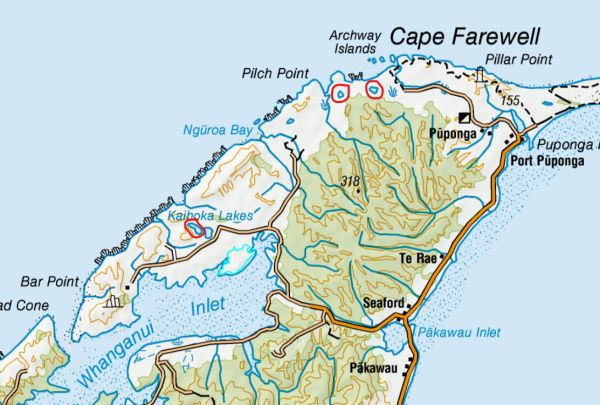
These lakes are circled in red below:
More information
We loosely call these blooms or scums “algae” as that is how most people will identify them. However, they are actually mostly cyanobacteria. Cyanobacteria inhabit all natural waters and are only problematic when they increase to high concentrations, forming ‘blooms’. Cyanobacterial blooms have occurred in many lakes in Aotearoa for over 50 years; however, they have become increasingly frequent in recent decades, possibly influenced by anthropogenic eutrophication and climate change.
A variety of physical, chemical and biological factors, which can vary between water bodies, influence the growth of cyanobacteria and the formation of blooms water bodies. Cyanobacteria are mostly planktonic i.e. they drift or float in the water column. They are now known to produce chemicals that are very toxic to humans and other animals.
Health risks
The health risks associated with cyanotoxins are greatest during bloom events when high cell concentrations are present in a water body. People using water bodies for recreational purposes are most likely to experience maximum exposure when a cyanobacterial bloom develops or forms surface scums near water entry points (should they come in contact with or accidentally ingest contaminated water). If consumed in high enough quantities, can cause illness or death to people and pets.
Wind-driven accumulations of surface scums can result in toxin concentrations increasing by a factor of 1,000 or more, and such situations can change within very short periods, even just hours.
Please see the following for more information: Aotearoa New Zealand Guidelines for Cyanobacteria in Recreational Freshwaters(external link)
The following toxin-producing “algae” have been found at Lake Whupa (in summer/Autumn 2026): Microcystis, Dolichospermum, Geitlerinema cf. splendidum, Picocyanobacteria, Phormidium.
The following were also found but are not known to be toxic: Pseudoanabaenaceae, Ceratium.
For information on water quality at these lakes, please see: Environmental monitoring reports.(external link)