Several nests of the Asian yellow-legged hornet (Vespa velutina), also known as the Asian predatory wasp, have recently been discovered in Auckland.
This is an alarming find, as these large hornets prey on honeybees that are essential for pollinating crops and honey production. Needless to say, we’re keen for these stingers to stay clear of our patch.
In Tasman, we have four accidentally introduced social wasp species that are commonly seen, particularly through spring and autumn. Two of these are similar looking – the common and German wasps (both being Vespula wasp species), while the European and Asian paper wasps (both Polistes species) are also almost identical.
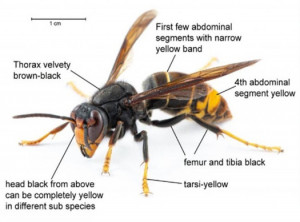 All of these wasps have yellow legs, so they could potentially be mistaken for yellow-legged hornets. The key difference is the size – yellow-legged hornet queens are around 3cm long and the worker hornets measure in at around 2cm.
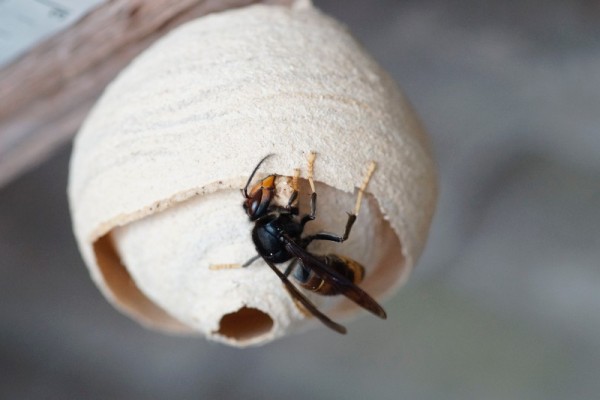
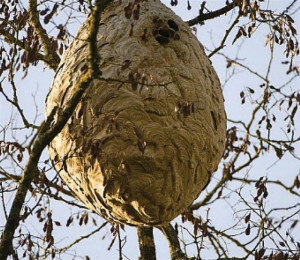
Yellow-legged hornet nests are different to paper wasp nests in shape and structure. They are round with an entrance hole at the bottom and are roughly the shape of a huge egg which can measure 80cm across.
Two nests are produced each year; the first one is smaller, about the size of a tennis ball, and often built on a shrubby plant (image 3 below). The second one is larger and built on a higher tree (image 1 above).
These hornets are variable in colour, but generally have a brown or black thorax. The abdomen is brown with yellow margins on the segments, except the fourth segment, which is orange. The head is black, and the face and legs are yellow.
The females have a formidable sting. In Europe, where they have also been accidentally introduced, several fatalities have been recorded from stings.
If you suspect you have seen a hornet or its nest, please take a photo from a safe distance and contact our Biosecurity team on 03 543 8400 or [email protected].