

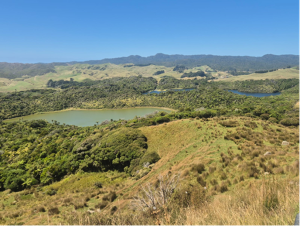
It’s unfortunate to report the presence of a significant cyanobacteria bloom in Lake Whupa, the western of the two Kaihoka Lakes, located north of Whanganui Inlet.
We are currently at an ‘Alert’ risk level, and as such, the bloom presents a possible health risk for people, stock, or dogs interacting with the lake water.
The risk is relatively low; however, the public is advised to take caution. We will continue to monitor the water in the hope of some improvement.
We are grateful to the landowners around the lake who have put in place measures to reduce this risk.
This situation may have been brought on by a wetter than normal period over summer, bringing in more nutrients.
Reports produced in the last few years (and available on our website) show that both Kaihoka Lakes were in slightly nutrient-enriched states.
“The thing with lakes is that once they have flipped to this degraded state, it is very hard and potentially expensive to try and return them to their former water quality”, says our Principal Scientist Trevor James.
“We also need to acknowledge the contribution of nutrients from wildfowl; however, we do not know the proportion of the nutrients that get supplied to this lake from this source.”
The cyanobacteria bloom will likely dissipate in the cooler winter months when the lake fully mixes, and the bloom will sink to the bottom of the lake. Then the potential health risk will subside.
Currently, Lake Whupa is a green-brown colour compared to the clearer water and blue reflection of the eastern Kaihoka Lake, where there is no bloom.