

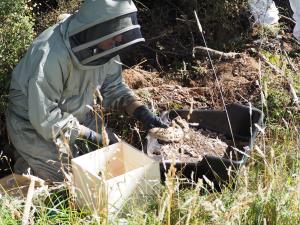
Following the release of wasp hoverfly biocontrol agents in 2024 and 2025 at Ronga Valley and Wainui Inlet, a second biocontrol agent – the parasitoid wasp Sphecophaga vesparum – was recently introduced into the Howard Valley to help control invasive Vespula (German and common) wasps.
We carried out this work in collaboration with New Zealand Institute for Bioeconomy Science staff.
These parasitoid wasps have a very specific life cycle that targets pest Vespula wasp nests. Adult females enter active nests and lay their eggs inside the brood cells. When the larvae hatch, they attach to developing wasp larvae and feed on them. This prevents the wasp larvae from maturing into adults, gradually reducing the size and strength of the colony over time.
This species was previously released in the 1980s in Hanmer Springs and the Pelorus River, albeit somewhat unsuccessfully. The parasitoid wasps used at the time came from Switzerland and were not genetically well matched to New Zealand’s wasp populations, which originated from the United Kingdom.
The Howard Valley programme has taken a more targeted approach, using a UK strain of Sphecophaga that is genetically a better match to local wasps.
In late February, three active nests of common wasps were carefully dug up and placed into specially prepared boxes. The parasitoid cocoons and adults were then introduced directly into the nests, giving immediate access to the wasp brood.
This more direct method is expected to improve the chances of establishment and increase its impact on wasp populations. While this approach will not eliminate wasps entirely, it aims to reduce their numbers and lessen their impact on native ecosystems.